Mrs. J currently lives in Vancouver, B.C., Canada.
Mrs. J's Folio
  • Welcome
  • ePortfolio
    • Standard 1
    • Standard 2
    • Standard 3
    • Standard 4
    • Standard 5
    • Standard 6
    • Standard 7
    • Standard 8
  • OLTD Portfolio
    • OLTD 501
    • OLTD 502
    • OLTD 503
    • OLTD 504
    • OLTD 505
    • OLTD 506
    • OLTD 508
    • OLTD 509
    • OLTD 510
    • OLTD 511
  • Breaking Barriers: Inquiry-Based Learning
    • Foundations of Education
    • Social Justice
    • The Inclusive Classroom
    • Community Action Project
  • Resources for Online Learning
  • My Learning Journey
  • About Me
  • Contact Me
  • ELL Post-Grad
    • ELL 1
    • ELL 2
    • ELL Specialist
    • TLIS
    • Student Assessment and Evaluation

Three Steps Forward, Two Steps Back

1/23/2016

0 Comments

 
This was an exciting, positive, incredible week... so why do I feel like drowning?

First, the exceptional:

Before the break, I had submitted a proposal for an exchange between our girls and the boys at a nearby private school to do artwork. The girls were to go to their school to work on ceramics, and the boys would come to our school to work on printmaking.  Since both our schools are segregated, this would be an opportunity for a low-key coed ongoing activity without the pressures of an actual event. This Tuesday the 19th, the proposal was accepted! The principal said it was a great initiative. When I told the girls, they were beaming, and after a little paperwork, we have a bus set up for us this upcoming Thursday.

More importantly, my mural project was also approved by the principal, who took the time to sit with me, encourage the project and praise the design. The wood was purchased this week, and it is smooth and perfect for the mural; I will draw the design on Monday, and the girls who will participate are extremely excited about the project, particularly Jessica, the talented grade 11 girl who designed the overall mural idea.

To top it off, I was asked to give a presentation to the whole senior school during assembly on the 22nd. The topic they asked me to talk about was my experiences, twists and turns between being an almost-dentist in Brazil to being an artist teaching at a private school. More importantly, the administration said they wanted me to reveal the secret for being joyful (they caught me hopping and singing to school, oops!)

I  hadn't done any public speaking for the past 20 years, but I made a good slideshow, and in the end, the girls had laughed so hard... everyone had a really good time, including me. Finally today, I went to an all-day pro-D about apps in iPad, and it was very informative.

Now, the negative:

Because my improv team had their big performance the previous Thursday January 14th, I missed OLTD class. I had hoped to catch up during the weekend, but I got the flu -- which is why I didn't teach until Tuesday. I also missed my Monday meeting with my OLTD group, when we were going to continue our discussion regarding our group seminar. A paper which was due this week remained unfinished until tonight. With all the commotion, I have spent the whole week trying to catch up to all the work, but worst of all, I feel very disconnected from the OLTD group. In fact, Wednesday I was considering dropping out of class and waiting this one off until next time.

I can't help but think that, if as an adult, I feel disconnected and overwhelmed, a kid who for some reason misses online class must feel much worse. I think this is probably one of the reasons online courses have such a high drop-out rate... the lack of face-to-face really makes one feel like the ship has sailed and no one even realized you stayed at the dock. There is no one for you to approach after school and ask for notes. How important it is for us to build a strong community with our online students! How can this be further improved? Zoom and Collaborate are good, but how else can we keep our fingers on everyone's pulse? I can't wait to see what comes down the line, and how much online learning will improve in the next ten years.

0 Comments

#collaborationimage

1/7/2016

4 Comments

 
We were prompted by our professor of OLTD 503 to design an image that represented our experience with Online Teaching and Learning so far. As I reflected on what image could be a good representation, I thought back on my experiences with the Internet, and  the magical world we have available under our fingertips;  how amazing it is to be able to reach and create these meaningful connections with each other, so far away. In my experience, relationships through the Internet can be even more real than face to face, as the defenses and facade we often hold up are removed and we are able to relax. We hear a lot about faking things on the Internet, but in my experience, people can be very sincere and honest through the Internet, and you can get to know a whole lot about someone very fast -- things that you would normally learn very slowly. Creating connections through the Internet often drives people to tell a great deal about their ideas and inner considerations, something we are very guarded naturally to do face to face.

This image came to mind: 

Connections

Picture
This is a simple collage of several images I found on the Internet -- I thought that was apropos :)

Online, each one of us is the master puppeteer of our own learning; we only get as much as we want. But with every keystroke, we make connections with other real individuals out there. Our thoughts and ideas become interlinked, like a giant cat's cradle, and everyone contributes to the knowledge base. In a way, we are all teachers and students; we should encourage our students to get "entangled", to create content, to interact and explore. Without getting their fingers "tangled" on others' thoughts and work, without the interaction between people, then all we are left with is a boring database, with no soul. I am looking forward to encouraging meaning-making and connections between my students, so that they can become excited about their own learning.


** Sources for images are as follows:
Keyboard: http://masterblog.front.lv/wp-content/uploads/2007/03/benkey_2.jpg
Hands: http://2.bp.blogspot.com/-q3sPesSK44c/TgFTqLR2pyI/AAAAAAAAASw/MhQBgQwdVzM/s1600/grabbing-hand-psd19419.png
World: https://adjustingcourse.files.wordpress.com/2013/07/blog-pic-11.jpg


4 Comments

Mural Proposal is Out!

12/23/2015

1 Comment

 
Planning a new mural has been a very good experience, in great part due to the OLTD program I am currently attending. Reviewing educational theories and processes has helped me plan this activity thoroughly, in a way that makes it easier for me to defend its value. The proposal I originally wrote was very long, and so I have attached here a summary for the proposed mural which will be built at York House. This shorter version has been submitted and I am waiting for approval. However, thanks to the work I did writing the longer proposal under the UbD framework, I am able to talk about the benefits and process of building the mural much easier.

I noticed something that is a little unrelated, but which is a reflection regarding my teaching, and I thought it would be good to mention. Seems like I can read something complicated and simplify it really well, which is the good news. Students have told me that my tutorials are easy to follow, despite being long. This brings me to the bad news: when I am left alone writing a paper, I can write a lot. A lot, a lot! Mostly, it is easy to read, if you don't fall asleep midway. That is a little bit of a bummer. I am planning on writing a book for teens, and I am wondering how that will turn out. Will the writer win, or the summarizer? I have a story that I would love to tell, but unfortunately I don't have an ending for it yet, and knowing me, that is a big problem. Maybe I should wait until the end appears before I start writing, otherwise it could just go on forever.


york_house_school_mural_summary.docx
File Size: 5320 kb
File Type: docx
Download File

1 Comment

Understanding by Design in an Online Setting

12/2/2015

2 Comments

 
Since I started learning about pedagogy and methods of teaching, I found the premise of Understanding by Design very attractive and natural to me. The process of defining what I want students to learn, then thinking about methods of assessing those blocks of learning, and finally filling in activities to bring that understanding forward, made a lot of sense. However, I have to admit that after thinking of my goals, I usually went straight to the activities, and never really did track down to see what activities were contributing to which goal.

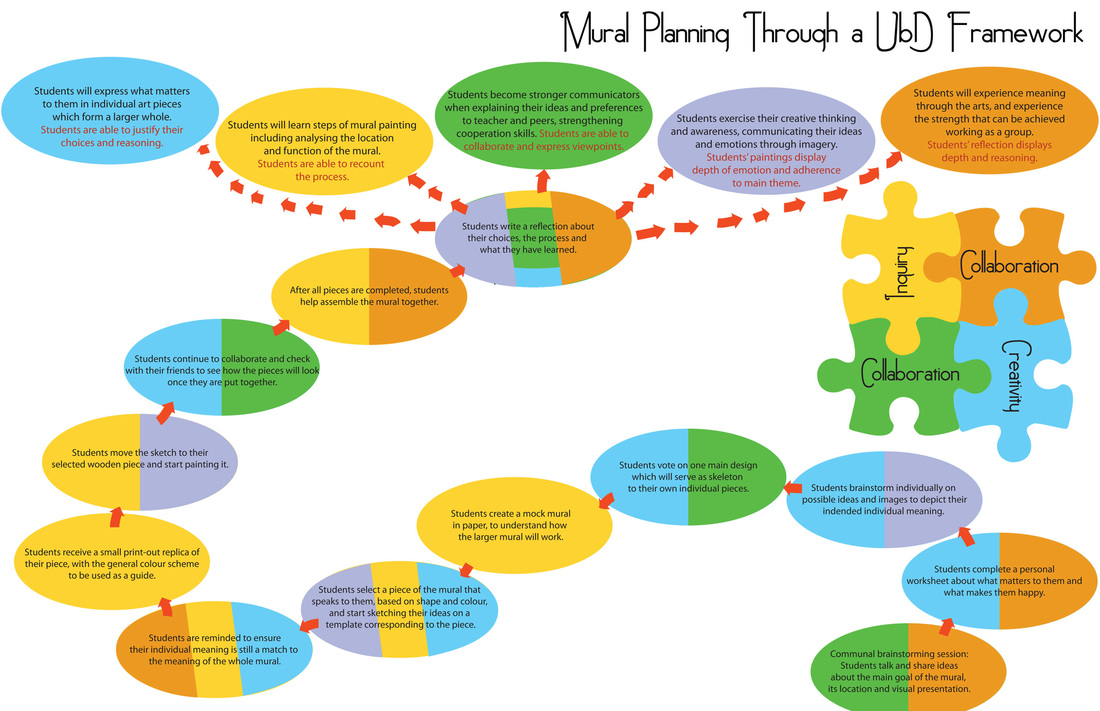
That's one of the reasons I am happy we revisited Understanding by Design on my 502 class. This gave me a chance to look back at activities I had done before, and focus on one that I would have done differently, or planned better. I decided to pick mural planning because I am about to work on two new murals -- one with grade 9s, and one with grade 11s and 12s. Besides using the three step process to design the lesson, I also kept in focus another important detail of Understanding by Design, which is ensuring the student learns transferable skills, that can become a part of the student knowledge and can be used in the future.

Forcing myself to write the goals down also made them sound much more concrete than before. In retrospect, my goals were basic: "students finish mural" and "students depict their favourite things" and "students reflect on their work". That's what happens when you don't write things down, I suppose! That was a problem, specially because this mural (and other activities that incorporate inquiry and Sparks) are supposed to be easily followed online by other teachers, should they choose to do so. Without clear goals and a good reason why, how could I expect others to take on such daunting projects?

My five new goals are much more true to what I am actually trying to coach students towards. One of the most important portions of their learning, the ability to communicate and come to an agreement, to collaborate and work on something big together, was nowhere to be found. Under my replanned activity, communication is everywhere! 

On my final graphic, I used a colour coordinated system in order to track down which activities addressed which goals. This is also a huge improvement from my previous tracking system, which was... well, none. I knew the activity was helping achieve a goal, but since nothing was tracked, nothing was clear. I found out through the graph, the activities usually touch upon at least two goals.

Also, I noticed that by defining the assessment piece before jotting down my activities, I was able to add activities that allowed for more demonstrations of learning. Encouraging students to continue to collaborate to make sure the pieces fit, for instance, is not something I had done previously; I did notice a few students were doing this on their own, and those pieces looked better together than the rest. So, this activity is good towards the goal of collaborating, it is natural for students, and it makes the final result a stronger piece, besides matching the assessment piece "Students are able to collaborate and express viewpoints".
Picture
I probably won't do a graph such as this for every activity I do, but I am trying to design an excel spreadsheet that serves a similar function. I think the cross-referencing and colour coding is particularly helpful to track which activities help which goals. This graph is, however, an excellent thing to make available online, as a way for teachers who want to undertake these large inquiry projects to validate their efforts. It is also valuable when showing the administration of the school, as it explains the why and how of mural creation, and the value in this activity.

Guiding students through an inquiry project on an online setting is one of my dreams. To do something like this, however, it is important to define my goals and the steps to be taken in a simple and straightforward manner.

My next step in this process will be to create a student-centered guide to this creative inquiry process. So far, I have a lot for teachers, but not a whole lot for students. But there is time!
2 Comments

Fostering 21st Century Skills - A Curious Enterprise

11/29/2015

3 Comments

 
I was thinking of a topic to bring to my blog, and kept coming back to 21st Century Skills. I think that's a big buzzword right now, and teachers are encouraged to focus on those more and more. We now know how important these skills are in the modern world, and still we realize how distant the majority of institutions are from embracing this change in focus. A slow revolution has started to brew, with a rising number of teachers and schools everywhere trying to figure out what is the best way to encourage these skills.

Traditional education was built around the idea of conformity; every child would get the same education, the same opportunities, display their learning the same way, and hopefully get out of the system with the same basic skills. But there are a couple of issues with this thinking.

One, people are not all the same. We learn differently, have different interests, backgrounds, strengths and weaknesses. Trying to fit everyone through the same mold ends up grinding all that is best and unique about every one of our learners until they start to question their essence, until they permanently conform or give up completely.  Some still think, what is so bad about conforming to a specific mold, anyway?

This brings me to the second issue with traditional education: it is meant to control and oppress, to create perfect workers instead of independent thinkers. I could talk about this for hours -- maybe I'll go on and on in another blog!

By squashing critical thinking, students start to conform to an expectation that should no longer be the focus. The traditional system encourages fear of failure, less risk-taking, and a sense that the only way to succeed is to play by the rules. Successful students finish grade 12 with high marks, but without the ability to bounce back if life takes an unexpected turn. Globalism and technology had a profound impact on our society, and change is necessary in order to develop adaptable lifelong learners.

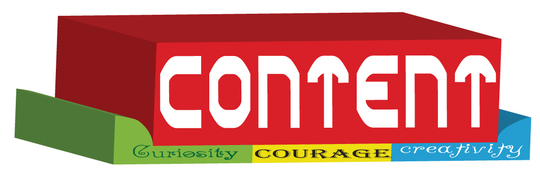
In short, a focus on content above all creates someone who is great at that content, but no longer an individual.  All the important attributes they had as young children get squished away.

Picture

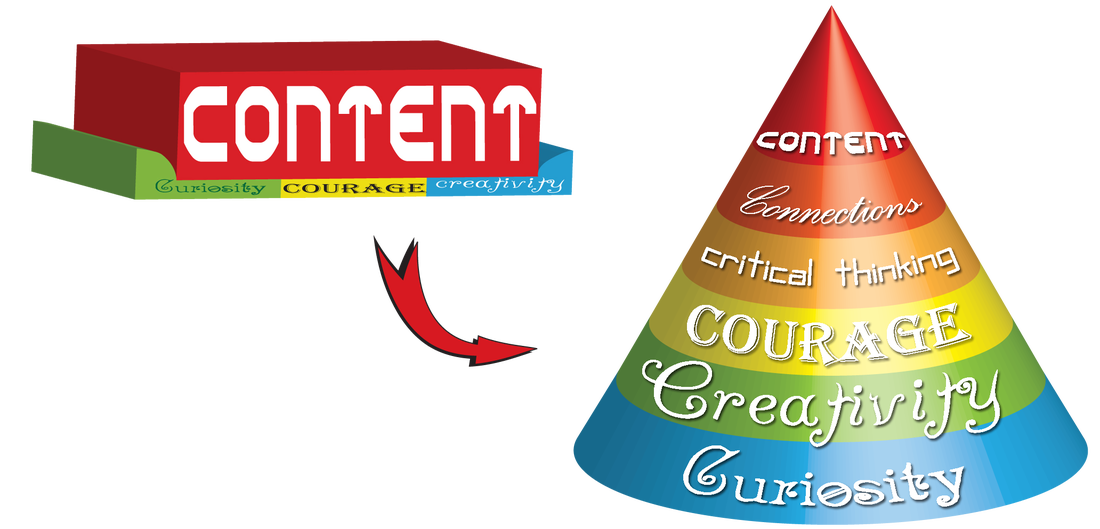
Will it really matter in 15 years if the child was able to memorize word by word a certain portion of a book? No. But it will matter if the child has learned to think for herself; to have confidence in her abilities to solve problems; to be a creative thinker, regardless of the scenario.

But if these skills are so important, how do we change things in our own classrooms? How to get from a heavy content to a point where 21st Century skills start to develop?

Turns out that creativity is something that can be encouraged and developed; children are born creative and willing to take risks. For us as educators to bring back that sense of wonder and creativity in our students, the best way is to encourage their curiosity. When content is given less of a focus, and curiosity is allowed space in the classroom, we end up seeing other skills appear.

Picture

But how can we encourage something like curiosity? How can we encourage students to think about different possibilities instead of trying to please us and give us the "right" answer?

I've come up with some ideas that can encourage this to happen, and these are very useful for a face-to-face and blended models; some of the ideas can also be adapted to online learning.

1. Create a double-entry journal between you and the students, where you can start a dialogue with them regarding your subject. No judgment! Welcome and honour all ideas, even the negative ones. This will help you quickly build trust, which is necessary when encouraging curiosity and risk-taking.

2. Bring make-believe into classroom. A good way to bring the drier bits of your content to a better light is to include them in some sort of make-believe. For instance, I had success teaching mitosis and meiosis by moving all chairs out of the way and getting the students to become a part of the cell, with students lassoing other students to divide the DNA equally. Afterwards, still on the circle, they were encouraged to describe what had happened, and participation was very high.

3. No words (or very few words) on slideshows. On slideshows, I have usually pictures and one or two words to provide focus and spark conversation. The students are encouraged to describe what they see, and I often get them out of their chairs and around me. This brings me to...

4. Get them out of their seats, asking questions. The division between you as expert and the student as learner should not exist anymore; you are their coach in this road to learning, and as such, you should encourage the students to huddle together around you. Being closer to other students also takes the spotlight from them and gives them better confidence to venture and shout out ideas. Debates should always be done out of their seats.

5. Mix it up. Whenever possible, bring lessons where they can build, reenact, experience or create in an open-ended way, such as models, crafts, building sets, posters, plays, music, reenactments, etc. This can be done for every single subject out there.

6. Remember there is no right or wrong for creative activities. Every answer shouted is a good answer; if nothing else, it took courage to bring it up, and that should be encouraged. Find what is good about the answer and respond accordingly. "Well, yes, I like your thinking, rats could be marsupials, after all they look just like possums. Anyone else has a different idea?"

7. Finally, every day, try to bring an interesting question about your subject, and don't give any answers until the next day. I like bringing an experiment or a slide and asking students to explain what is going on, taking their best guess. The first couple of times, students were concerned about voicing their opinions, but after that, they realized how there was no judgment, and those last few minutes of class became a bubbly, crazy time where all of them participated with ideas and suppositions, building upon each others' thoughts and conceptions. This was a perfect example of controlled chaos, something we can talk about later in more detail. THIS is  the most important way to foster curiosity -- open-ended questions force students to allow for multiple answers and to be creative. Knowing the answer won't be given today also keeps the conversation bubbling.

If you have more ideas, please comment below. I have used these successfully in my classroom when teaching Science, and I really think these can be used when teaching any subject!

Boy. I do talk a lot!
3 Comments

Learning new tools and also new things!

11/20/2015

2 Comments

 
Lindsey, Helene and I just finished a big project for class. We really got into the research regarding the differences between online learning, face-to-face and blended learning. All the different angles regarding learning were fun to discuss, and I particularly loved Lindsey's idea of looking at learning from a learner's perspective. This made it so much easier, and really shaped our presentation.

Technically, I was particularly interested on learning Powtoon as a tool for presentations. Back when I was doing the Education program, I wanted very much to use it, but soon I realized that It was not as easy to produce something the way I had envisioned... this time, I really stuck my heels down and went for it. Perseverance really pays off when it comes to learning new tools, and I am happy I did that. Now I want to prepare other presentations on different topics. I think my next one will be assessment.

My favourite thing was writing the script and thinking of the timing, and what scenes I would bring to make the story come to life. Coming from a background in illustration and creative editing, I found that I enjoyed writing the flow of the story very much, but interestingly enough, my editing could have been done much better. I've heard the quote "I wrote a long letter because I did not have time to make it short" which originally I thought was attributed to Mark Twain... but it seems he was quoting Blaise Pascal (1623-1662). I could say that the repetition and different ways to say the same thing were intentional and not for lack of more time to edit, but I think my brain was just too fried to make it sound interesting as well as short.  

I had a great time with my grade 9 students as well, who were more than happy to make a little skit for me to include in the presentation. Although they all said they would not like to be doing an online course strictly from home at the moment -- they said they would lack the motivation and discipline to finish the course without meeting the teacher regularly. I thought that was interesting and it also made sense given their young age and the fact that they are used to this structure and thrive in it. The unknown can make us nervous in the beginning. 

You can watch the presentation below, or click here to watch on Youtube. Feel free to comment on it. The voice over text has been pasted directly below.
Does Learning Take Place Differently in Online and Blended Learning Environments?
​By Angela Jurgensen, Lindsey Watford and Helene Berube
​Does learning take place differently in online and blended learning environments?

As educators, one of the things that most concerns us is the learning process. We want to do the best for our students and ensure they assimilate the subject. We want to make sure we are using the right learning theories, (at the right time)… and that we keep current with the latest ideas in this digital age. …So, instead of simply looking at differences between online, blended and face to face environments, and trying to figure out which one would be better for teaching one subject or another, let’s first look at learning with a focus on the most important piece of the learning puzzle: (money?) No no... (content?) Nope... The learner.

The first question to ask ourselves, is, who is our learner?

Is he on elementary school, on secondary school, or is he a more mature learner?

Is she a kinesthetic learner? Tactile? Visual? Does she learn better reading by herself, watching a video or listening to an audio tape?

Is this a student who needs someone looking over their shoulders, or is this a self-motivated learner?
It is very likely that you have a combination of these students in your classroom, virtual or otherwise.

The next question to ask ourselves is, what is the student learning?

Is this a chapter that requires memorization? Is the student required to do a lab, or maybe perfect a manual skill? Is this a class where technology is an absolute requirement for project completion, or can the student demonstrate his learning through more traditional means? And perhaps most importantly, is the student gathering 21st Century skills and tools that will stick with him long after school is over?

We should also consider the student’s psyche when determining what delivery method would be most successful.

So, why the student has selected online or blended learning versus brick and mortar?
Many students require a certain flexibility to their learning. Some students suffer from anxiety regarding presentations, group work and even going to school, for a variety of reasons. Some have illnesses that stop them from getting out of their homes. Some students require individual learning plans with specific adaptations for their success. Sometimes, a student and a teacher will not be compatible due to a variety of reasons. In these cases, the flexibility of an online course can be very beneficial.

For other students, a face-to-face component is required. These are students who perhaps thrive in social opportunities, or who require a more immediate academic support and feedback. A student who is not self-motivated may find a purely online module insufficient to encourage learning, and may require a face-to-face approach.

A blended learning course offers the anytime, anywhere approach of an online course, but with the checkpoints and face-to-face meetings with the teacher, and can be very useful for students who need the flexibility of learning at their own time, while still having the human connection of a face-to-face check point.

This brings us to where this particular student will be most successful in their learning. While brick and mortar is limited to a geographic location and a predetermined time, the time for online learning is defined by the learner, on the learner’s terms. Students who are travelling or living abroad may need a way to remain connected to their classroom; Students who are working already, or who practice sports or otherwise need to work on odd hours on their coursework, respond better to the more unstructured option offered by online learning.

Let’s look at some of the differences in regards to delivery methods:

As far as course design, it’s a tie. “Doing it right” means that the material is delivered with the learner and the learning in focus, and that adequate support is provided, as well as accounting for differentiation. A constructivist and connectivist approach is particularly important when working with students online.

Relationship between teacher and students. On a face to face, teachers can be pretty traditional, and still learning can occur. On an online-only environment, for actual learning to occur, the teacher has to become more of a guide and allow students to make decisions. Simply putting a traditional coursework online and expecting learning to occur is not very successful. While on a face-to-face setting, confident students tend to dominate the classroom, students who are shy or anxious have an easier time asking the teacher online.

Hands on learning – Labs online have to be pretty creative, and are mostly demonstrations and virtual labs.

Inquiry process: It can be more challenging to set up a successful inquiry unit online. Delivery should be done in chunks, with clear goals and expectations. The results, however, can be quite amazing, with deep learning that will last for a lifetime.

Behavior issues: While teaching face to face can sometimes feel like swatting a barrel of monkeys, online needs minimal classroom management.

Oral presentations: These are much easier for students who attend online courses. The flexibility in methods of delivery can make students suffering from anxiety or stage fright feel finally at ease.
 
Collaboration: With the increasing improvements of online communication, this has become easier every year. Now, students can collaborate with other students from across the globe to produce creative displays of their learning, and sharing these online to their peers is a great motivator. Nowadays, young people are used to collaborating and sharing online, and it’s easy for us to tap into this naturally. So, the student role in an online setting is very different from the student role in traditional classrooms.

(Student: Traditionally passive learner - > active participant and creator of knowledge)

So, to answer the original question, does learning happen differently in an online and blended environment? The answer is, it depends on a variety of factors; the student, the teacher and the method by which the material is presented. Technology can be a very attractive and powerful tool, but it must be used creatively in order to be successful, under a student-centered umbrella.
​
In an ideal world, great and long-lasting learning can happen in a classroom just as often as through an online course. To quote Stephen Downes, “We need to move beyond the idea that an education is something provided for us, and toward the idea that an education is something that we create for ourselves.” If we create our own education, then we must consider that we are merely guides towards our students’ road to discovery. The key is finding ways to engage each and every different style of learner with the material, no matter if you meet every day, every week or if you never meet at all. Regardless of the location of your classroom, there is simply no denying the amazing opportunities for deep learning, collaboration and growth that technology brings. The interest and comfort with technology has been growing every year, and learning different tools to reach our students can only strengthen their learning process.
2 Comments

Online and Blended Learning - Return of the Road Runner

11/20/2015

1 Comment

 
I have been extremely busy these past few weeks. This is my first year teaching; since I graduated from the Bachelor of Education in January, and I already have had a variety of experiences. I started off as a TOC in January, and by March, had secured a temporary position with Woodlands Secondary in Nanaimo, and stayed until the end of the year. This full-time position was a very exciting mixture of opposites; on one side, I had two foods classes, where we got to experiment with neat recipes and have a fun, relaxing time -- very much like Arts in a way. The other two blocks were Information Technology blocks, and I was able to expand upon the tutorial series I started back on my Practicum.

This tutorial series was a logical thing for me; I wanted to make sure that students who missed class were able to finish their work without being left behind, and I wanted to allow for students who were ahead to simply go forward and work on a new tutorial. So, I put these tutorials online, and everything was working hunky dory, with me just going from student to student when necessary. They all worked at their own pace; they were happy, and I was happy. It was a very relaxing class to run, and I allowed for so much customization of the results, the students really enjoyed it. I caught one student asking another, the following semester, "What's your favourite teacher?" and the student answered, "Mrs. J!" and he started describing how I had been so cool and had allowed for him to make a composition with dragons and swords on Photoshop, and how I let them have their own pace.

Only when I started course 502 from my masters, I realized that what I had been doing for the past couple of years was basically blended learning. It's interesting how you can do something and not realize that the thing has a name.

I feel that way about many things in regards to Education. There was this paper we were supposed to write during the Education program, and it was an action-based project in which we had to observe students and take conclusions. By the end of it, I thought I had figured out some things all by myself, such as that when content is given less weight, it allows for other, more important qualities and strengths to emerge -- I thought it was interesting how all of the qualities I thought of started with a C --  and how these were the qualities we should be focusing on. As it turns out, these things I thought I had come up with had a name: 21st Century skills. Not being a part of the education community and living a very different life before I started this path, I have no knowledge of the buzzwords and the truths that so many Educators take for granted, and I find that most of my 'knowledge' is still based on what feels right, what looks right and what works.

I would like to read more and have time to learn all the theory. I feel there is so much I don't know by heart yet. Although I am very new, I can at least take comfort that some of the things that I believe in are considered right by people who are way more knowledgeable than me, if that makes sense. Einstein said once that "Imagination is more important than knowledge, for knowledge is limited to all we now know and understand, while imagination embraces the entire world, and all there ever will be to know and understand". So maybe the fact that I think of how things should be without knowing what is the proper way, makes me a decent educator. Sometimes, just like the Road Runner, not knowing the way things are done can be a good thing. If you don't know the limits, then the laws of Physics don't apply... and it's harder to fall.
1 Comment

My Learning Journey

10/25/2015

2 Comments

 
The past two months have been truly an amazing adventure. Since I graduated in January, life has been a constant stream of exciting and new learning opportunities.
2 Comments
Forward>>

    Author

    I'm a teacher who loves to write. Don't get me started! Oh well, too late...

    Archives

    February 2017
    January 2017
    June 2016
    April 2016
    January 2016
    December 2015
    November 2015
    October 2015

    Categories

    All

    RSS Feed

Powered by Create your own unique website with customizable templates.